Viking · Error codes
Viking Refrigerator Error Codes
A Viking 5 Series built-in has no letter-and-number codes on its panel. It reports trouble with its nine indicator bars, a few lights and a tone, and the only true code list sits on the compressor inverter behind the top grille, where a technician reads it as a count of blinks.
$79 service call, applied to the repair. Monday to Saturday, 8 AM to 7 PM.
In short: HIGH TEMP with a blinking section light means that section has run warm for about two hours. Bars 4 through 7 lighting one after another, with a tone, means a temperature sensor circuit has opened. Every bar flashing means the power was interrupted. A blue light two places right of HIGH TEMP is showroom mode, and three blue squares with the rest of the panel dark is Sabbath mode; neither is a fault. Meanings vary by model and production era, so treat this page as a guide for the units it names.
Which Viking refrigerators this page covers
Everything below applies to the electronic-control built-ins Viking documented around 2009 and 2010, all with the same control family and a variable-speed compressor:
- Side-by-sides, 42 and 48 inches: VCSB542 and VCSB548, VISB542 and VISB548, DDSB542 and DDSB548, DFSB542 and DFSB548. A D at the end, as in VCSB548D, adds the ice and water dispenser.
- Bottom-mounts, 36 inches: VCBB536, VIBB536, DDBB536 and DFBB536, with the freezer as a drawer.
The model and serial are on a plate at the upper left of the door opening, and the first six digits of the serial are the month, day and year it was built. Older Viking built-ins and later Viking refrigeration use different controls, so the same light can mean something else on them; we read those on site. How these units are built is on Viking refrigerator repair.
How the 5 Series panel shows a problem
The control panel sits at the top of the fresh-food opening, behind the door. It stays asleep until you press ACTIVATE CONTROLS; only ALARM OFF works without that first press. Once awake, the nine bars show the setting of whichever section you pick, one bar the warmest and nine the coldest, with five as the factory midpoint. They show a setting, not a measured temperature.
Around the bars are lights for the freezer, the refrigerator, HIGH TEMP, the door alarm, MAX REF and MAX FRZ, plus small blue and orange LEDs that mark special modes. A tone joins any alarm. ALARM OFF stops the tone, but the light keeps blinking until the cause clears, and an alarm whose cause is still there comes back.
Alarms the panel can raise
Temperature and sensors
| Code or display | What it means | What to do |
|---|---|---|
| Tone, HIGH TEMP lit, freezer or refrigerator light blinking | The blinking section has stayed too warm for about two hours | Check the doors and the food, clear the top grille, and call if it does not recover within a few hours. |
| Tone, a section light on, bars 4 to 7 lighting in turn | The sensor circuit for that section has opened: the sensor, its plug or its wire. The control cannot regulate that section | Press ALARM OFF. If the scrolling returns, call; an open sensor usually stops cooling. |
| HIGH TEMP alarm that clears and returns over days | Usually a fault that comes and goes: defrost, a fan, or a door that does not always seal | Note the times it sounds and what the food felt like. |
Power and doors
| Code or display | What it means | What to do |
|---|---|---|
| Every temperature bar flashing | The unit has just been powered up: after an outage, a tripped breaker, or the power switch behind the top grille being turned off | Press ALARM OFF or ACTIVATE CONTROLS. If the outage was long, check the food. |
| Tone, door light blinking | A door has been open longer than the delay, three minutes from the factory | Close it. If it was closed, the door is not sealing or its switch is not reading it. |
| Door alarm never sounds | It has been switched off on the panel, or the unit is in Sabbath mode | Press ACTIVATE CONTROLS, then hold ALARM OFF for three seconds to turn it back on. |
Displays that look like a fault but are settings
| Code or display | What it means | What to do |
|---|---|---|
| Blue LED two places right of HIGH TEMP | Showroom mode: the panel works normally, but compressor, fans and defrost are held off, and the warm and sensor alarms are silenced | Hold ACTIVATE CONTROLS, add HIGHER and ALARM OFF, and keep all three down until the third beep. |
| Three blue squares on the right, everything else dark, no interior light | Sabbath mode: lights, display and alarms are off while cooling continues | Hold ACTIVATE CONTROLS and DISPLAY OFF for three seconds, then lower the ice maker arm, which is raised for Sabbath. |
| Panel dark, keys ignored | The display was switched off, or the panel is asleep | Press ACTIVATE CONTROLS. If nothing lights and the unit is silent, check the breaker and the power switch. |
| MAX REF or MAX FRZ lit | A section running at its coldest for a few hours, four from the factory, then returning to its setting | Nothing, or press the same key to end it early. |
| Orange LED right of HIGH TEMP | The control is in its service program, the mode a technician uses to read sensors and change settings | Leave the keys alone. It exits by itself after about ten minutes without saving anything. |
| Unit running, no interior lights | Sabbath mode, or a lighting circuit fault | Rule out Sabbath first. |
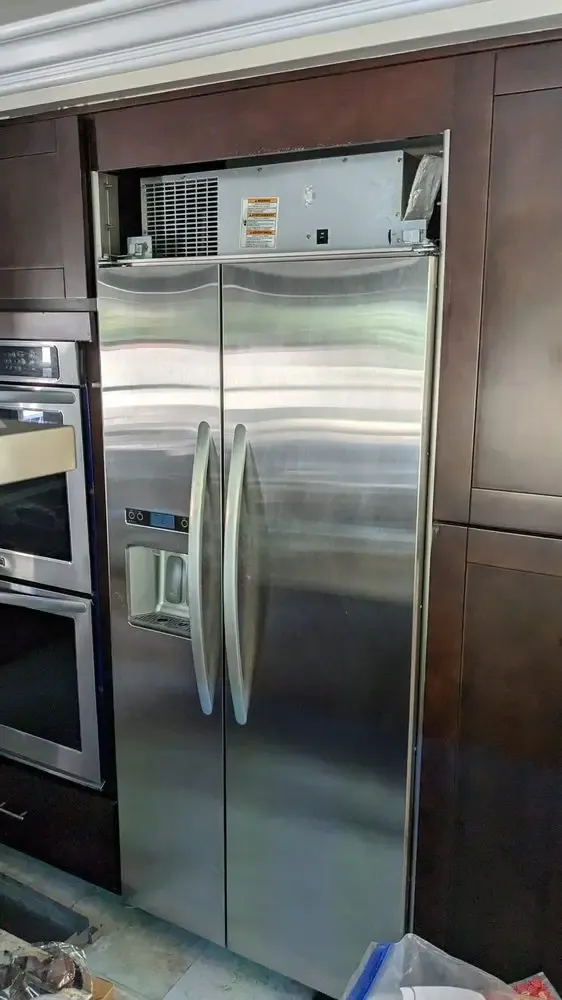
The compressor inverter's blink codes
The compressor on these units is driven by an inverter board in the machine compartment above the cabinet. The control sends it a speed signal, and the inverter powers the compressor. A small LED on the inverter reports its state as a count of blinks. It sits behind the grille and the control housing, next to line-voltage wiring, so it is a technician check, but knowing the list helps you follow what we find.
| Inverter LED | What it means | What it usually leads to |
|---|---|---|
| One blink about every 15 seconds, compressor running | No fault seen by the inverter | If the unit is still warm, the cause is elsewhere: condenser, fans, defrost, sealed system. |
| One blink about every 15 seconds, compressor off when it should run | The inverter is fine but nothing is asking it to run | A sensor reading wrong, or the control board not calling for cooling. |
| Two blinks about every 5 seconds | No speed signal reaching the inverter from the control | The signal cable and its plugs first, then the inverter or the board. |
| Three blinks about every 5 seconds | The inverter cannot drive the compressor | The cable between the inverter and the compressor, the compressor's motor, or the inverter itself. |
| Four blinks about every 5 seconds | A compressor fault | Electrical tests on the compressor tell a failed compressor from a wiring fault. |
| LED dark | No power reaching the inverter, or a dead inverter | Supply to the inverter is checked before the board is replaced. |
We order a part only when the same blink code comes back after a restart and our own electrical tests agree with it.
Problems the panel does not flag
Several common faults set off no alarm at all, or only the HIGH TEMP alarm after the damage is done. These are the ones we look for when the lights are quiet.
| What you see | System | What it usually is |
|---|---|---|
| Runs all the time, freezer very cold | Sensors | A shorted freezer sensor reads warm all the time, so the compressor keeps running. A dirty condenser or a failing fan also stretches run time. |
| Frost across the freezer back wall | Defrost | The defrost heater, the switch on the coil that ends defrost, or the freezer fan. |
| Water under the kickplate | Drain pan | A cabinet out of level, or the float switch or heater that evaporates the melt water in the pan under the unit. |
| No ice, freezer cold | Ice and water | The ice maker arm still raised, often after Sabbath mode, the supply valve, the water valve or the fill tube. |
| Dispenser slow or dead, ice maker fine | Ice and water | One of the two water valves the water passes through, or, on units built from May 19, 2010, the relay that switches the first valve. Parts differ before and after that date, so we check the serial first. |
| Runs a few degrees off its setting after a repair | Controls | On the side-by-sides, a replacement control board arrives with sensor offsets that match none of the side-by-side models, so it runs warm or cold until it is set for yours. We check the offsets on every board we fit. |
| Compressor waits several minutes after a restart | Controls | Normal. The control holds the compressor off for a few minutes after it stops, to protect it. |
For the cooling side in depth, see Viking refrigerator not cooling, and for ice, Viking ice maker not working.
What these alarms turn out to be on a visit
- HIGH TEMP: most often a condenser matted with dust, a fan that stopped, or frost choking the freezer coil. A failed compressor or inverter is less common, and we confirm it with the blink code and measurements before anything is ordered.
- Scrolling bars 4 to 7: as often a loose or corroded plug as a dead sensor. We measure the sensor at the board and at the plug before replacing it.
- Every bar flashing: usually an outage or a breaker. If it happens with no outage, we look at the outlet, the power switch and the supply.
- Door alarm with the door shut: a gasket folded or flattened, a door that no longer swings closed, or a door switch out of position. See built-in refrigerator repair for door and hinge work.
- Warm with a quiet panel: rule out showroom mode first, especially after a move, a remodel or a new installation.
Stay safe. If water is spreading from under the unit, close the water supply valve first. Turn the power switch behind the top grille or the breaker off before you clean the condenser, and do not reach past the grille toward the boards or the inverter, which carry line voltage. Do not switch the unit off and on repeatedly to clear an alarm, and never open refrigerant tubing.
What the repair costs
Reading the panel lights and the inverter LED is part of the diagnosis on the $79 service call, which is credited to the repair once you approve the written price. Typical ranges for built-in refrigeration:
Built-in refrigerator and freezer repair (Sub-Zero, Thermador, Viking, Monogram, Miele)
| Repair | Typical price, parts and labor |
|---|---|
| Condenser cleaning and performance check | $150 to $250 |
| Condenser fan motor | $350 to $600 |
| Evaporator fan motor | $350 to $650 |
| Temperature sensor (thermistor) | $250 to $450 |
| Defrost heater or defrost termination | $350 to $650 |
| Water valve | $300 to $550 |
| Door gasket, per door | $300 to $600 |
| Door hinge or closer cam | $300 to $650 |
| Ice maker assembly | $450 to $900 |
| Electronic control board | $650 to $1,300 |
| Refrigerant leak repair and recharge | $900 to $2,000 |
| Evaporator replacement | $1,200 to $2,500 |
| Compressor replacement (sealed system) | from $2,000 |
Typical Orange County ranges for parts and labor. The $79 service call is applied to any of them. Parts that ship from the manufacturer and older or discontinued models can run higher. You get the exact written price after the diagnosis and before any work starts.
A Viking board, sensor or inverter is ordered from a distributor and usually arrives in a few business days; we give you the wait before you decide. Sealed-system work is done in-house; see sealed-system repair. Other brands' codes are on the error codes page, and every Viking appliance we service is on Viking appliance repair. All prices: pricing.
Talk to the technician first
Monday to Saturday, 8 AM to 7 PM. The $79 service call is applied to the repair.
Viking refrigerator codes: questions
Does a Viking built-in refrigerator show error codes like E1 or F2?
Not the 5 Series built-ins. Their panel uses the nine bars, a few lights and a tone. The only numbered code is the blink count on the compressor inverter, which a technician reads behind the top grille.
What does it mean when the lights scroll across my Viking panel?
Bars 4 through 7 lighting in turn, with a tone, mean a temperature sensor circuit has opened. Press ALARM OFF; if it returns, the sensor or its wiring needs testing, and the unit may stop cooling.
Why does my Viking refrigerator keep beeping?
Usually a door open past three minutes, a section warm for about two hours, or a sensor alarm. The lights show which one. ALARM OFF silences it, but an unsolved cause brings it back.
How do I turn the door alarm off or back on?
Press ACTIVATE CONTROLS, then hold ALARM OFF for three seconds. The same press turns it back on. How long the door may stay open before it sounds is a service setting.
My Viking shows only three blue squares and the light is off. Is it broken?
No, that is Sabbath mode. Hold ACTIVATE CONTROLS and DISPLAY OFF for three seconds to leave it, then push the ice maker arm back down so ice production resumes.
Can a new control board make my Viking run too warm or too cold?
On a side-by-side, yes, if it is not set up: a replacement board ships with sensor offsets that suit none of those models. We set the offsets for your model on any board we fit and confirm temperatures with a thermometer before we leave.
Do these codes apply to my older or newer Viking refrigerator?
Only to the 5 Series side-by-sides and 36-inch bottom-mounts named above. Earlier and later Viking refrigeration uses other controls, and we read those on site.