Sealed systems · Orange County
Sealed-System Repair for Built-In Refrigerators
The compressor, condenser, evaporator and the tubing between them hold less than a pound of refrigerant in a closed loop. When that loop leaks, clogs or loses its compressor, we repair it in your kitchen, with the unit left in its opening on most models.
$79 service call, applied to the repair. Monday to Saturday, 8 AM to 7 PM.
- $79service call, applied to the repair you approve
- In-housesealed-system work: compressors, evaporators, leaks
- Since 2022CA BHGS #50388, EPA-certified
- 90 daysno-fee return visit if the same fault comes back
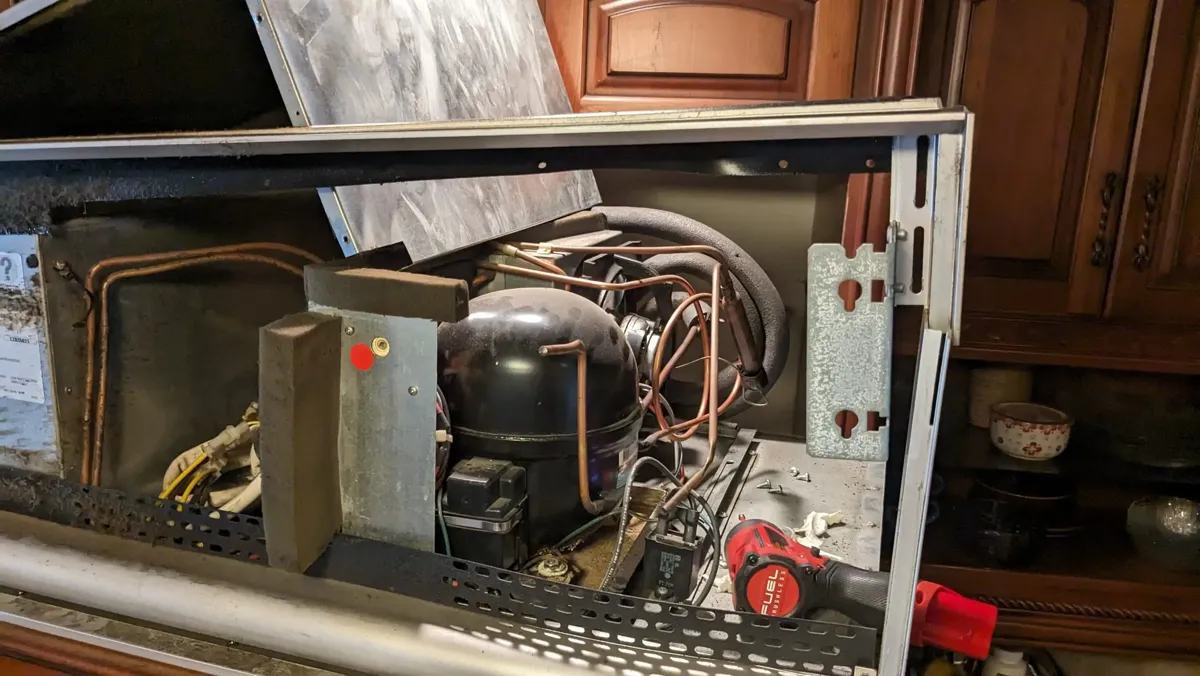
In short: sealed-system faults are rarer than a dirty coil, a fan or a defrost failure, so those get ruled out first. When the loop itself has failed, we repair the leak, evaporator, compressor, condenser or restriction in-house, with a new filter-drier, a deep vacuum and a charge weighed to the rating tag. We are EPA-certified for refrigerant work, and you see the written price before you decide.
What the sealed system is, on a built-in
The compressor pushes hot vapor to the condenser, where the fan carries the heat into the kitchen. The liquid passes a filter-drier and a hair-thin capillary tube into the evaporator, boils off there while absorbing heat, and returns. Refrigerant is not used up; a low charge went somewhere.
Built-ins add four things to every sealed-system job:
- Two systems on many models. Sub-Zero combination built-ins and pairs of columns have a loop per section, so one failure warms one side. We check the healthy one too.
- Variable-speed compressors. Later Sub-Zero Classic and Integrated units, Viking 5 Series, later Monogram built-ins and Fisher & Paykel columns run the compressor from a drive board. The board can fail while the compressor is fine.
- Tubing inside the cabinet. Hot refrigerant runs through a loop around the door openings to keep the frame from sweating, behind the gasket seat on Sub-Zero and foamed into the side panels and front frame on Miele freezers. A leak there is inside the insulation.
- A small, exact charge. A Sub-Zero Classic system holds a few ounces of R-134a, and isobutane systems are charged to the gram; Thermador's notes warn that losing a couple of grams already hurts cooling. The charge is weighed in to the rating tag.
Signs that point to the sealed system
- One section stays warm although the condenser is clean and both fans run.
- The compressor runs without stopping. Some controls log a fault on their own after a full day of continuous running.
- A click and a hum every few minutes, with no cooling in between.
- An oily film on tubing or at a joint you can see through the grille. Refrigerant carries compressor oil with it as it escapes.
Each of these can also come from a matted coil, an iced evaporator, a start part or a drive board. See not cooling, running constantly and compressor replacement.
How we diagnose before opening anything
Opening the loop is the step that cannot be taken back cheaply, so it comes last.
- Rule out the rest. Coil, fans, defrost, sensors, door seal and the stored fault history.
- Read the system from outside. Temperatures along the tubing, how hard the compressor works and how long it runs, compared with what the manufacturer expects for that model.
- Test the electrics. Compressor windings, the start parts or the drive, and whether the board is calling for cooling.
- Pressures only when needed. Most built-ins have no service ports, so gauges go on last, and only with fittings that will not leak afterward.
Together the readings show whether refrigerant has escaped, the flow is blocked or the compressor has stopped pumping, and we explain which one in plain terms before quoting.
The repairs we do in-house
Refrigerant leak
What it usually is: a pinhole in the evaporator, a cracked joint, a condenser eaten by salt air, tubing rubbed through by vibration, an old clamp valve, or the heater loop inside the frame.
What you might notice: cooling that fades over weeks, then a section that will not get cold.
What we do: find the leak, repair the joint or replace the part, and recharge by weight. When a leak has let air and moisture into the system, the compressor may need replacing too, and that is in the written price before we start. A leak inside the foam narrows the options, which we explain first. When a full repair is not the right spend yet, we tell you what a temporary measure can and cannot do. Our GE Monogram refrigerant leak at an Orange County police department (March 2025) was a small leak, sealed and recharged.
Evaporator replacement
What it usually is: a leak in the coil itself, where patching would not hold.
What you might notice: the same fading cooling.
What we do: remove shelves and the rear cover, change the coil inside the compartment and move or renew its defrost parts. The unit stays in its opening. On our Sub-Zero evaporator leak in Irvine (July 2026) the leak was in the coil; the owner chose a temporary measure for now, with a new evaporator recommended for later.
Compressor replacement
What it usually is: worn valves, a shorted or open winding, or a seized motor, after the drive board and start parts test good.
What you might notice: a warm section with a silent or clicking compressor, or one that runs and moves no heat.
What we do: replace it on the unit tray or through the toe kick. A compressor that fails young may be a warranty matter: on our failed Sub-Zero freezer compressor (July 2026) we confirmed the failure and pointed the owner to the manufacturer's warranty first.
Restriction, moisture or a bad earlier repair
What it usually is: ice or debris at the capillary tube, the narrowest point in the loop, often left by a repair that stood open too long. Or a system topped off without weighing the charge, or mixed refrigerants.
What you might notice: the compressor runs and the section warms anyway, or the unit never cooled right after a previous visit.
What we do: recover the refrigerant, flush the debris out, and replace the drier and, when it is plugged, the capillary (on a Sub-Zero it comes as one assembly with the suction line). After contamination a second drier goes in. Then the system is dried out and recharged by weight.
Brazed joints or LOKRING connectors
Tubing is joined by brazing with a torch or with LOKRING connectors, rings pressed over the tube ends with a sealant. Done properly, both last, and the refrigerant and the manufacturer's rule decide which we use.
- R-134a systems (most Sub-Zero, Viking, Monogram and Miele MasterCool units in service; newer models may differ, and the rating tag names the refrigerant): brazed or LOKRING, whichever suits the joint and the manufacturer's instructions. Sub-Zero publishes LOKRING fittings for its Classic, Integrated, 700, PRO 48 and 400 series.
- Isobutane (R-600a) systems (Thermador Freedom columns and the bottom-mounts shared with Bosch and Gaggenau, newer Miele freezers, Fisher & Paykel columns, Dacor built-ins): the refrigerant is flammable. Thermador's instructions rule out a torch on the circuit entirely, so every joint there is a LOKRING. We ventilate the kitchen and follow each maker's rule.
A LOKRING holds when the ring matches the tube and the tube is clean, so we size and prepare every joint.
How the system is closed up
The old refrigerant is recovered, not vented. Once the failed part is replaced, the system is cleaned out, tested for leaks, dried and refilled with the exact amount of new refrigerant on the rating tag. The filter-drier is replaced as part of the job. Then we run it and check the temperatures before we leave.
Older units and R-12
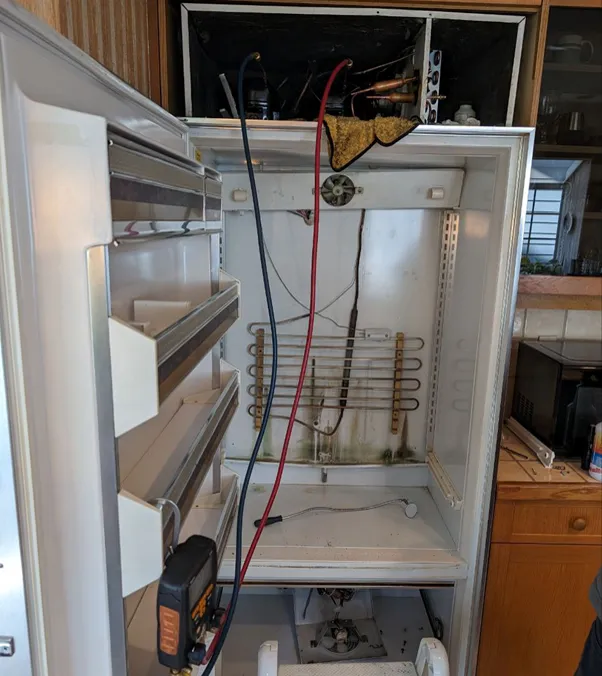
Units built before the industry moved to R-134a in the 1990s ran on R-12, which is no longer made. A sealed-system repair on one usually becomes a conversion, since R-12 now comes only from reclaimed stock, and a conversion takes more labor than a like-for-like job. Old Sub-Zeros can still be worth a full rebuild, as our 46-year-old Sub-Zero (May 2024) showed: both compressors, the condenser, the evaporator and the tubing were replaced. See vintage Sub-Zero repair.
Is a sealed-system repair worth it?
On a sound cabinet with good doors, usually yes: even a compressor job costs a fraction of a new built-in with panels and installation. It makes less sense when both systems are worn or the liner or frame is failing. Check the warranty first. On many Sub-Zero, Monogram and Viking built-ins of the last two decades, sealed-system parts were covered to about the twelfth year, with labor for the first five or six. The repair or replace guide and Sub-Zero lifespan guide go further.
What sealed-system repair costs
The $79 service call covers the trip and the diagnosis and is applied to the repair you approve. Sealed-system work is in the last three rows.
Built-in refrigerator and freezer repair (Sub-Zero, Thermador, Viking, Monogram, Miele)
| Repair | Typical price, parts and labor |
|---|---|
| Condenser cleaning and performance check | $150 to $250 |
| Condenser fan motor | $350 to $600 |
| Evaporator fan motor | $350 to $650 |
| Temperature sensor (thermistor) | $250 to $450 |
| Defrost heater or defrost termination | $350 to $650 |
| Water valve | $300 to $550 |
| Door gasket, per door | $300 to $600 |
| Door hinge or closer cam | $300 to $650 |
| Ice maker assembly | $450 to $900 |
| Electronic control board | $650 to $1,300 |
| Refrigerant leak repair and recharge | $900 to $2,000 |
| Evaporator replacement | $1,200 to $2,500 |
| Compressor replacement (sealed system) | from $2,000 |
Typical Orange County ranges for parts and labor. The $79 service call is applied to any of them. Parts that ship from the manufacturer and older or discontinued models can run higher. You get the exact written price after the diagnosis and before any work starts.
Other built-in work is under built-in refrigerator repair, wine units under wine storage, the rest under services and pricing.
Talk to the technician first
Monday to Saturday, 8 AM to 7 PM. The $79 service call is applied to the repair.
Sealed-system repair: questions
Can a refrigerant leak on a built-in really be fixed?
Usually. Leaks at joints, condensers and evaporators are repaired or the part is replaced. A leak buried in the cabinet foam is the hard case, and we explain the options first.
Is a LOKRING joint as reliable as a brazed one?
Yes, when the ring matches the tube and the tube end is clean. Several manufacturers require it, and Thermador allows no other joint on its circuits.
Do you repair isobutane (R-600a) refrigerators?
Yes, including Thermador and Fisher & Paykel columns. We work with the kitchen ventilated, no open flame on the circuit, and a charge weighed to the gram.
Does the refrigerator have to come out of the cabinet?
Rarely for sealed-system work. The compressor sits on a tray or behind the toe kick and comes out the front; only a leak inside the insulation means sliding the whole unit out, and that is in the written price.
How long will we be without the refrigerator?
Parts usually take a few business days, then the repair is one long visit. The section needs several hours to a day to reach its set point.
Is my built-in's sealed system still under warranty?
Possibly, if it is under about twelve years old. Many luxury brands covered sealed-system parts that long, labor only early on. Check your paperwork and call the manufacturer first.