Monogram · Troubleshooting
Monogram Refrigerator Not Cooling
A Monogram ZIS built-in side-by-side cools both sections from one coil in the freezer ceiling, so the warm side tells us where to look. A warm fresh-food side beside a cold freezer usually means the damper, the freezer fan or frost; both sections warm points to the condenser, the compressor drive or the sealed system.
$79 service call, applied to the repair. Monday to Saturday, 8 AM to 7 PM.
In short: make sure the display does not read OFF, give any setting change a full day, and measure with a thermometer rather than by feel. With the breaker off, look at the condenser behind the top grille. Then match what you see to the patterns below. Once the fresh-food side reads above 40°F, move perishables to a cooler with ice; food above 40°F for two hours or more should be thrown out.
Integrated columns and bottom-freezer Monogram models are built differently; call with the model number and we will tell you what applies.
First, the checks you can do yourself
A thermometer, a flashlight and a soft brush are enough, and none of this goes near wiring or refrigerant.
- Read the display, not the lights. OFF means cooling was switched off at the panel; the lights stay on either way. On the 2016 models a minus pad turns cooling back on at 37°F and 0°F. On dial units, the freezer dial has its own off position.
- Check the set points and wait. Around 37°F and 0°F is normal; after any change, wait 24 hours. The 2016 displays show the real temperature, which rises for a while after a big grocery load or a defrost.
- Measure. A thermometer in a glass of water on a middle shelf, read after several hours of closed doors, beats any display. Mid to high 30s and a freezer near zero is healthy.
- Look at the condenser. Switch off the breaker, lift or remove the top grille (on recent models the same panel you lift for the water filter) and look at the coil. If it is furred with dust, brush and vacuum it gently.
- Feel the air at the grille. Put the grille back, then restore power. While the unit runs, warm air should come out through the grille; on 2004 and later models the compressor is so quiet that airflow is a better clue than sound.
- Check the doors. Each door should pull itself shut from partway open, with the door tops level and no folded gasket.
- Clear the air path. Keep packages off the fan cover at the top of the freezer and the air tower slots on the fresh-food back wall; on dial units, also the return louvers at the lower left.
Read the pattern
| What you notice | What it usually points to | Next step |
|---|---|---|
| Fresh food warm, freezer cold | Damper stuck shut, freezer fan weak, frost blocking the duct, or a fresh-food sensor | Clear the air tower and check for frost, then call |
| Both warm, little or no air out of the grille | Clogged condenser, stopped condenser fan, main board or inverter | Clean the coil; if the airflow stays weak, call |
| Both warm, fans running, grille air barely warm | Compressor drive, compressor, or refrigerant loss | Call; do not keep restarting it |
| Frost across the freezer ceiling, ice on its floor, water under the drawers | Defrost failure or a frozen drain | Do not chip the ice; call |
| Freezer soft, fresh food fine, unit in a cool room or garage | Room too cold for the control to run the compressor enough | Warm the space; call if the room is normal |
| Display and lights normal, nothing running, no OFF shown | A showroom setting left on, the main board, or the inverter | Call |
What it usually turns out to be
Condenser blocked or condenser fan stopped
What it usually is: the most common cause on every generation. The coil cannot shed heat, the compressor runs long and hot, and both sections creep up together.
What you can check: the coil, with the breaker off.
What we do: clean the coil and test the fan and its supply.
Freezer fan slow or stopped
What it usually is: the fan at the top of the freezer is all that moves cold air to the fresh-food side, so that side warms first. On dial units a small switch holds the fan off after defrost until the coil is cold; if it fails open, the fan never restarts.
What you can check: listen at the top of the freezer. A squeal before silence suggests a worn motor.
What we do: test the motor, its supply and its speed signal, and clear any ice around it.
Damper stuck shut
What it usually is: the motorized damper at the top of the fresh-food side stops opening, and fresh food climbs into the 40s and 50s beside a cold freezer. On dial units the damper is mechanical, and its sensing bulb runs the section warm if it shifts against metal.
What you can check: that nothing tall is pressed against the top of the fresh-food section.
What we do: cycle the damper from the service menu, measure its motor, and replace it.
Defrost failure
What it usually is: a heater, the coil sensor, the high-limit switch or the drain trough heater fails. If the heater never warms, the control ends the defrost on its timer and keeps cooling, so frost thickens over days until air cannot pass. The 2016 control also logs the timed-out heater as a fault, which we read from the service menu. On dial units a worn timer can stall in defrost.
What you can check: white frost on the freezer ceiling or back wall.
What we do: find the failed part, replace it, thaw the coil, clear the drain and confirm the next defrost.
Sensors and the main board
What it usually is: a sensor reading wrong, a lost link between the touch panel and the main board, or a board output that no longer switches.
What you can check: settings that change on their own, or temperatures that jump.
What we do: read the stored faults, check each sensor against a reference thermometer, and test the board before replacing it.
Inverter or compressor (2004 and later)
What it usually is: the compressor runs only through its inverter board. A failed inverter, a missing run signal or a failed compressor all leave the display working while nothing gets cold; the drive keeps retrying on its own, which is why restarting it at the breaker does not help.
What you can check: nothing; it sits behind the grille next to live wiring.
What we do: measure the run signal, the inverter output and the compressor windings, so a failed drive is not mistaken for a failed compressor.
Refrigerant leak or restriction
What it usually is: the least common cause, and the one we rule out last, after the condenser, fans and defrost check out. A leak in a tube foamed into the cabinet is the hard case, and we explain the options before you decide.
What you can check: nothing safely.
What we do: confirm the leak before any sealed-system price is written. Our March 2025 job at a police department in Orange County, GE Monogram refrigerator not cooling: refrigerant leak, was exactly this. See sealed-system repair.
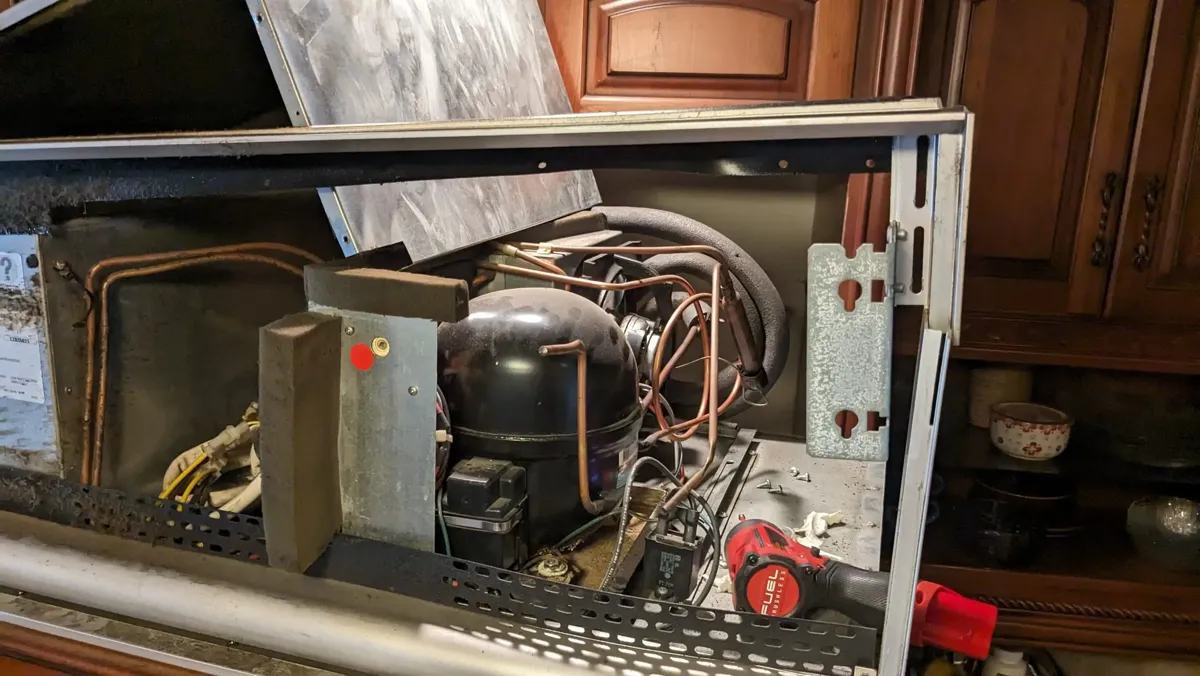
Protect the food and the unit. As soon as the fresh-food side reads above 40°F, move milk, meat, fish and leftovers to a cooler with ice, and throw out perishables that have been above 40°F for two hours or more. Switch off at the breaker before opening the grille, since the inverter stays live with the cooling off. Never chip ice off the coil or open refrigerant tubing.
What the repair costs
The $79 service call covers the visit and the diagnosis and comes off the repair once you approve the written price. Most not-cooling repairs fall in the condenser, fan, sensor and defrost rows of the built-in refrigerator repair ranges below; sealed-system rows apply only once a leak or a failed compressor is confirmed, and an inverter or damper is priced in writing.
Built-in refrigerator and freezer repair (Sub-Zero, Thermador, Viking, Monogram, Miele)
| Repair | Typical price, parts and labor |
|---|---|
| Condenser cleaning and performance check | $150 to $250 |
| Condenser fan motor | $350 to $600 |
| Evaporator fan motor | $350 to $650 |
| Temperature sensor (thermistor) | $250 to $450 |
| Defrost heater or defrost termination | $350 to $650 |
| Water valve | $300 to $550 |
| Door gasket, per door | $300 to $600 |
| Door hinge or closer cam | $300 to $650 |
| Ice maker assembly | $450 to $900 |
| Electronic control board | $650 to $1,300 |
| Refrigerant leak repair and recharge | $900 to $2,000 |
| Evaporator replacement | $1,200 to $2,500 |
| Compressor replacement (sealed system) | from $2,000 |
Typical Orange County ranges for parts and labor. The $79 service call is applied to any of them. Parts that ship from the manufacturer and older or discontinued models can run higher. You get the exact written price after the diagnosis and before any work starts.
See the pricing page, Monogram refrigerator repair for each generation, refrigerator maintenance and repair or replace.
Talk to the technician first
Monday to Saturday, 8 AM to 7 PM. The $79 service call is applied to the repair.
Monogram refrigerator not cooling: questions
Why is my Monogram freezer cold but the refrigerator warm?
The fresh-food side has no coil of its own. Its cold air comes from the freezer through a fan and a damper, so a stuck damper, a weak fan or frost in the duct gives exactly this pattern.
I cannot hear my Monogram compressor. Is it running?
On 2004 and later models it may well be; the inverter compressor is very quiet. Judge by warm air at the grille and a thermometer inside, and do not reach into the machine compartment while the unit has power.
Why is the bottom drawer warmer than the rest of the refrigerator?
It has its own controls. On 2002 and 2004 models it matches the fresh-food side when its features are off. On 2016 models, switched off it sits in the 40s, and it returns to off after an Express Chill.
How long does a Monogram take to get cold after a repair or a power cut?
Several hours for the fresh-food side and up to a day for a full freezer to settle.
Will unplugging my Monogram reset a cooling problem?
Once at the breaker is fine if the panel seems frozen. Repeated restarts do not fix a cooling fault, and a defrost fault can look cured for a day after the coil thaws.
Can a Monogram in a garage stop keeping the freezer cold?
Yes. In a room much below about 55°F the fresh-food side is satisfied so quickly that the compressor does not run enough for the freezer. Monogram also advises against rooms above about 100°F.
What should I do while I wait for the visit?
Keep the doors closed and the perishables in a cooler with ice, note what the display shows, and have the model number ready. If the condenser looked dusty, a gentle brushing with the power off is fine.
Can you come out today?
Usually same-day or next-day, Monday to Saturday, depending on the schedule. We are an independent service, not affiliated with GE Appliances.