Monogram · Built-in refrigeration
Monogram Built-In Refrigerator Repair
Monogram's ZIS built-in side-by-sides come in 36, 42 and 48-inch widths and changed far more inside than out: touch controls, then a variable-speed compressor with the 2004 models, then LED lighting, Wi-Fi and a stored fault log in 2016.
$79 service call, applied to the repair. Monday to Saturday, 8 AM to 7 PM.
- $79service call, applied to the repair you approve
- In-housesealed-system work: compressors, evaporators, leaks
- Since 2022CA BHGS #50388, EPA-certified
- 90 daysno-fee return visit if the same fault comes back
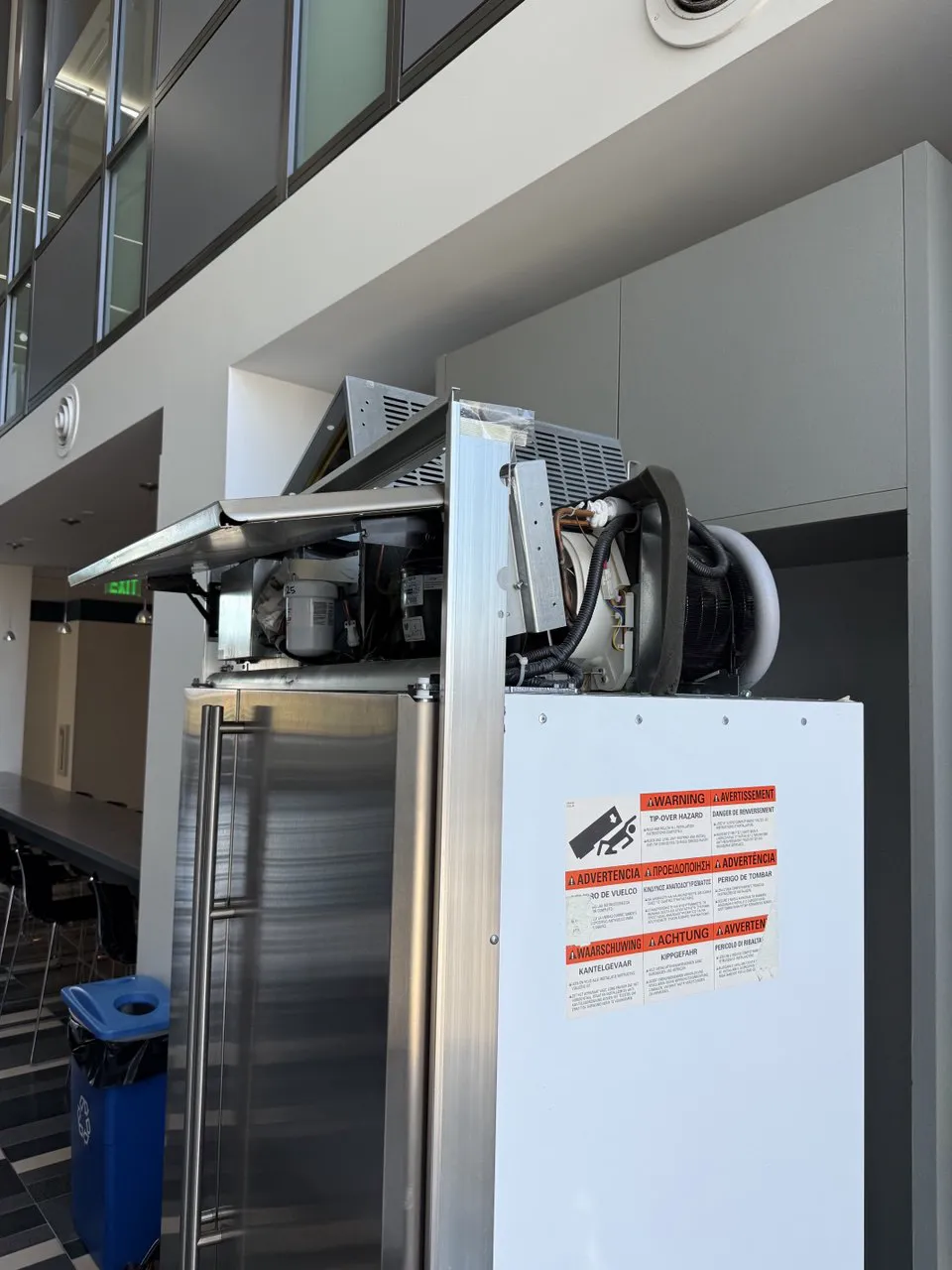
In short: every ZIS has a single cooling coil, at the top of the freezer, serving both sections. Most repairs, in order: the condenser or its fan, the freezer fan, defrost, the damper, sensors or board, and the inverter. We are an independent service, not affiliated with GE Appliances.
Which Monogram built-in do you have
The model number starts with ZIS: Z for Monogram, I for built-in, S for side-by-side. The next letter describes the outside: on 2002 and 2004 units a color (S stainless, B black, W white, none for a trim model made for custom panels); on 2016 units S for stainless or European style, P for Professional, B for a custom-panel door with a black dispenser, none for a custom-panel model. Then come the width, N or D (no dispenser or dispenser) and the model-year letter, which decides most parts.
| Generation | How to recognize it | What is inside |
|---|---|---|
| Dial controls (the original ZIS36, ZIS42, ZIS48) | Two numbered dials at the top rear of the fresh-food section | A thermostat for the compressor, a mechanical damper for the fresh-food side, a defrost timer |
| 2002 model year (ZIS…NM, ZIS…DM) | Touch panel, Climate Control drawer, halogen light towers | Main board on top, variable-speed freezer fan, motorized damper, adaptive defrost, single-speed compressor |
| 2004 model year (ZIS…NR, ZIS…DR) | Looks like the 2002 units | Variable-speed three-phase compressor run by a separate inverter board; fan speeds follow it |
| 2016 generation (ZISS, ZISP, and custom-panel ZIS and ZISB) | LED lighting, Wi-Fi, Custom Cool drawer, displays showing actual temperatures | Same layout and inverter compressor, plus a room sensor and a stored fault log |
In-between model years follow the nearest of these. The rating plate is behind the top grille on older units; on the 2016 generation the tag is on the right of the fresh-food floor, under the Custom Cool drawer. The serial's first letter is the month and its second the year (in LA, L is June). Year letters repeat every twelve years, so LA can be June 2001, June 2013 or June 2025, and the model number settles which.
How a Monogram built-in keeps cold
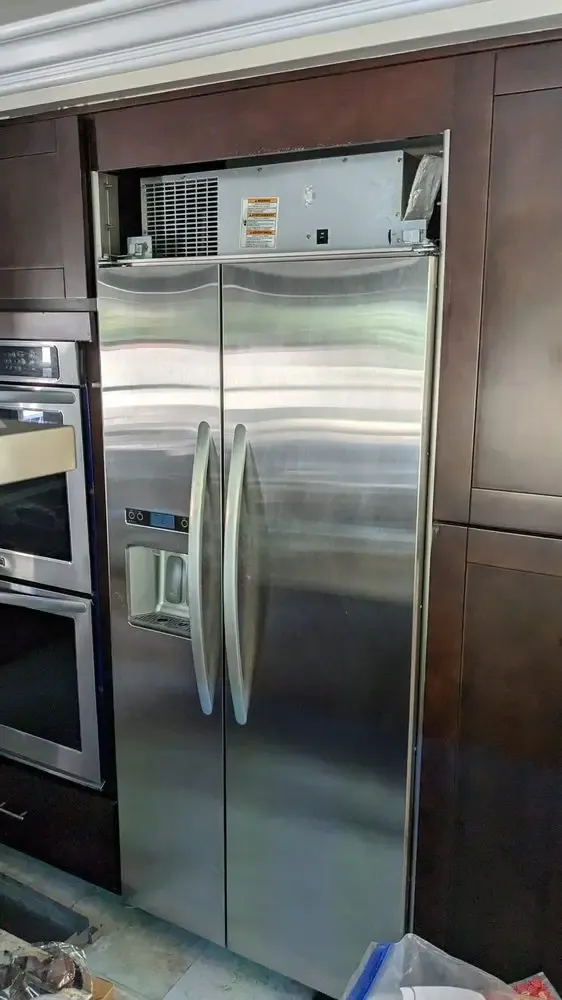
All generations share one layout: the compressor, condenser, fan and, on electronic models, the main board above the doors, and one coil at the top of the freezer. A fan blows its air through the freezer and, past a damper, down an air tower at the back of the fresh-food side, which has no coil of its own.
A warm refrigerant tube foamed in around the freezer opening keeps the frame from sweating; it cannot be replaced if it ever leaks.
The electronic models defrost after roughly eight to sixty hours of compressor running, the short end with heavy door use (up to ninety-six on 2016 units), and the compressor and fans rest for up to about 45 to 55 minutes each time. From 2004 on, the compressor runs longer and slower than older ones, so quietly that it is easy to think it has stopped.
What fails on a Monogram built-in, in the order we see it
Condenser and condenser fan
What it usually is: a dirty coil or a stopped fan behind the top grille, the most frequent repair on every generation. On 2002 units the condenser fan runs at one speed whenever the compressor runs; from 2004 it follows the compressor's speed, so a slow fan is not always a fault.
What you can check: the coil, with the breaker off, as described on Monogram refrigerator not cooling.
What we do: clean the coil and test the fan at the speed the board is asking for.
Freezer fan
What it usually is: the fan at the top of the freezer moves all the cold air in the cabinet, so the fresh-food side warms first when it fails. On the 2002 boards a shorted fan motor can burn its driver on the main board, and on the 2016 units an out-of-level defrost trough can let water freeze around the fan.
What you can check: listen at the top of the freezer, and keep packages off the fan cover behind the ice maker.
What we do: test the motor and its supply and replace what failed.
Defrost heater, coil sensor and drain
What it usually is: on dial units the defrost timer wears. On 2002 and later units the heater, its sensor, the high-limit switch or the drain heater fails, and the control ends each defrost on its timer and carries on while ice builds; the 2016 control logs it as a fault we can read. How that shows in the kitchen is on Monogram refrigerator not cooling.
What you can check: frost spreading across the freezer ceiling, ice on the freezer floor, or water under the drawers.
What we do: test each part, replace the failed one, thaw the coil and clear the drain.
Fresh-food damper
What it usually is: a motorized door behind the light housing at the top of the fresh-food side. Stuck shut, the fresh food warms beside a cold freezer; stuck open, it runs too cold. On dial units it is mechanical.
What you can check: nothing; it sits behind panels.
What we do: run and measure the damper, and replace the assembly. On the 2016 units it comes with the upper duct.
Sensors, main board and touch panel
What it usually is: a sensor reading wrong, or a touch panel and main board that stop talking, which makes control erratic.
What you can check: whether settings change on their own.
What we do: read the sensors against a reference thermometer, check the boards, and replace the part at fault.
Inverter and compressor (2004 and later)
What it usually is: the inverter makes three-phase power for the compressor. If the compressor will not start, the drive keeps trying again on its own, so resetting the breaker adds nothing. A failed inverter and a failed compressor look alike.
What you can check: nothing. The inverter is live whenever the refrigerator has power, even with the cooling switched off.
What we do: measure the run signal, the inverter and the windings. If the compressor has failed, the written price says whether the inverter might need replacing too; a new one goes in only if testing shows the drive failed.
Water valve, filter and ice maker
What it usually is: the valve and filter sit behind the grille. Hard water wears the valve, and an old filter or low house pressure slows the fill.
What you can check: the shutoff valve and the filter date.
What we do: test flow, the valve and the ice maker. See ice maker repair.
Lights, doors and gaskets
What it usually is: the halogen lights on 2002 and 2004 units run on transformers with heat cutouts that open if a door stays open too long; the 2016 units use LED and power boards. Heavy custom panels slowly pull the doors out of line.
What you can check: whether each door closes from halfway; and, with the breaker off, the master light switch behind the grille (two on 2016 units), refitting the grille before power goes back on.
What we do: trace the light circuit, adjust the hinges, and replace closer parts or gaskets.
Sealed system: leak or restriction
What it usually is: a refrigerant leak or a blockage. The electronic generations hold less than a pound of refrigerant, so a small loss shows quickly.
What you can check: nothing. If the condenser is clean and the fans run but it stays warm, call.
What we do: confirm with gauges, repair the leak, fit a new drier and weigh in the charge, as on our GE Monogram refrigerant leak repair at a police department in Orange County in March 2025. See sealed-system repair.
Repair or replace a Monogram built-in
On dial-control units, control and trim parts are scarce, so a sealed-system repair needs a frank talk first. The 2002 and 2004 units are past twenty years: the common parts are routine, some boards and halogen parts are getting hard to find, and we check by model before you commit. The 2016 generation is young for a built-in.
The warranty GE published with these models covered sealed-system parts through year twelve, with labor for the first five. It names the compressor, condenser, evaporator and tubing, not the inverter or fans. If a unit under twelve years old has a failed compressor or a leak, check with GE Appliances before paying anyone, including us. For the full decision, see repair or replace a built-in refrigerator.
What a Monogram refrigerator repair costs
The $79 service call covers the trip and the diagnosis and is applied to the repair once you approve the written price. Typical built-in refrigerator repair ranges:
Built-in refrigerator and freezer repair (Sub-Zero, Thermador, Viking, Monogram, Miele)
| Repair | Typical price, parts and labor |
|---|---|
| Condenser cleaning and performance check | $150 to $250 |
| Condenser fan motor | $350 to $600 |
| Evaporator fan motor | $350 to $650 |
| Temperature sensor (thermistor) | $250 to $450 |
| Defrost heater or defrost termination | $350 to $650 |
| Water valve | $300 to $550 |
| Door gasket, per door | $300 to $600 |
| Door hinge or closer cam | $300 to $650 |
| Ice maker assembly | $450 to $900 |
| Electronic control board | $650 to $1,300 |
| Refrigerant leak repair and recharge | $900 to $2,000 |
| Evaporator replacement | $1,200 to $2,500 |
| Compressor replacement (sealed system) | from $2,000 |
Typical Orange County ranges for parts and labor. The $79 service call is applied to any of them. Parts that ship from the manufacturer and older or discontinued models can run higher. You get the exact written price after the diagnosis and before any work starts.
See our pricing page, refrigerator maintenance and all Monogram repair.
Talk to the technician first
Monday to Saturday, 8 AM to 7 PM. The $79 service call is applied to the repair.
Monogram built-in refrigerator repair: questions
Why does my Monogram compressor run so long?
On 2004 and later units the variable-speed compressor runs longer, at lower speed, than older refrigerators, often more than half the time in a warm kitchen. Running nonstop for a day is not normal; the 2016 control logs it as a fault.
Why are the lights out when the refrigerator is still cold?
Switch off the breaker, check the master light switch behind the top grille, and refit the grille before restoring power. If the switch was on, the cause is usually a transformer, a heat cutout or a power board, not the lamps.
If the compressor fails, does the inverter have to be replaced too?
Not always. We test the drive before and after the compressor is replaced, and the written price tells you up front if a new inverter is a possibility.
Should I use the water filter if we have reverse osmosis?
No. Install the bypass plug in place of the filter. Filtering twice slows the flow and can leave the cubes hollow.
Is a 20-year-old Monogram built-in worth repairing?
Usually, if the cabinet and doors are sound. We check part availability by model before you decide.