Wolf · Microwave Drawers
Wolf Microwave Drawer Repair
A Wolf microwave drawer is a microwave oven on a motorized slide. When it will not open, close or heat, the cause is usually the drive, a safety switch, the fuse those switches protect, or the high-voltage parts, and the repair is done with the drawer slid out of its opening onto padding.
$79 service call, applied to the repair. Monday to Saturday, 8 AM to 7 PM.
- $79service call, applied to the repair you approve
- In-housesealed-system work: compressors, evaporators, leaks
- Since 2022CA BHGS #50388, EPA-certified
- 90 daysno-fee return visit if the same fault comes back
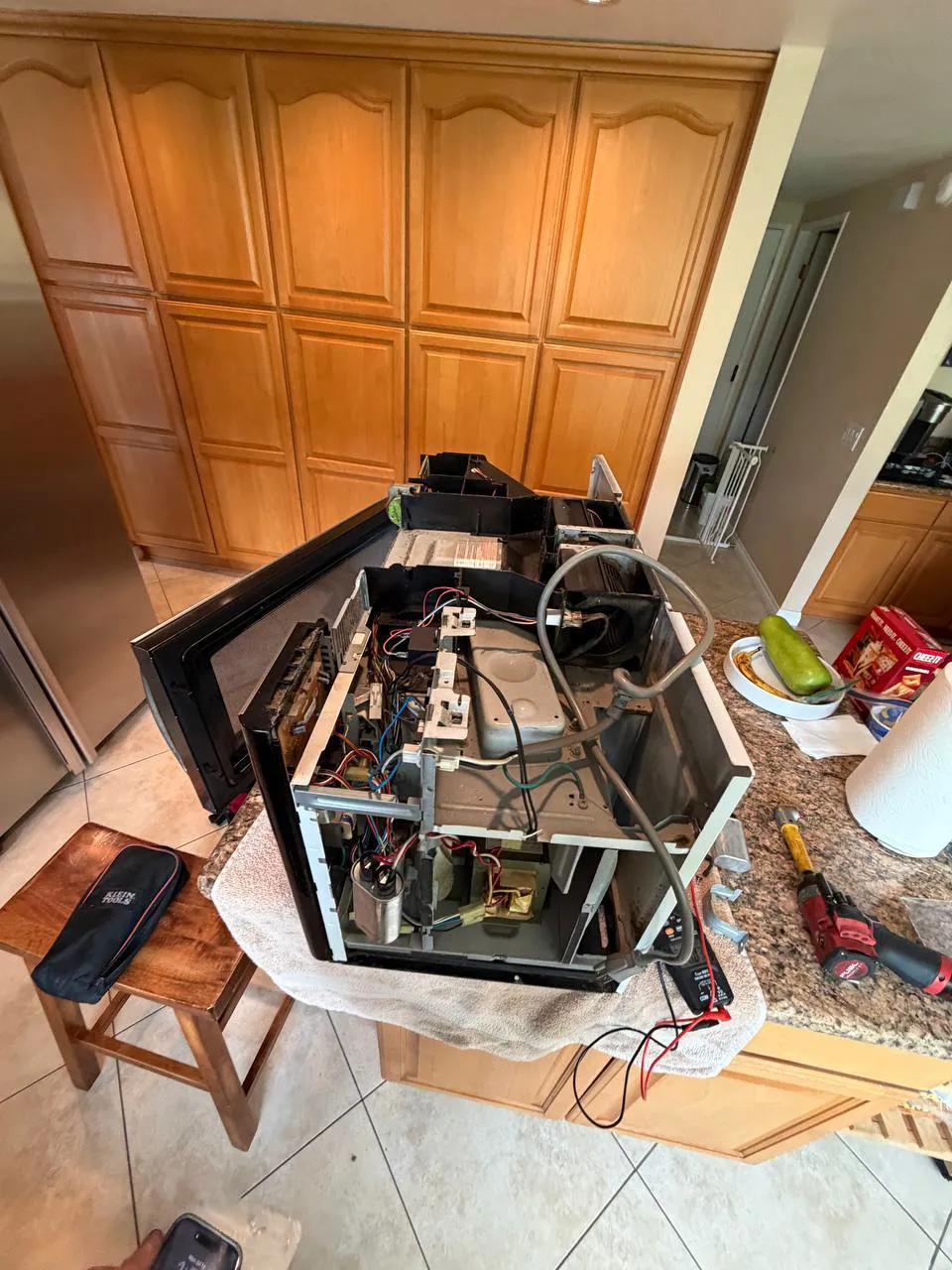
In short: open and close the drawer with the touch pads only, keep the drawer guides free of crumbs, and never lean on the open drawer. A drawer that stops partway or will not move is usually the drive or its position switches. One that runs without heating points at the magnetron and high-voltage parts, and a completely dead unit often at a fuse blown by a safety switch. These are technician repairs: a microwave holds a dangerous charge even unplugged.
Identifying your Wolf microwave drawer
- MWD24-2 and MWD30-2. The drawers in Wolf's 2009 service literature, rated at 950 watts. The 24 inch goes under a counter or in an island; the 30 inch is sized to sit below a Wolf E series wall oven.
- Later drawers. Model numbers starting MD, such as MD24TE or MD30PE, styled to match Wolf's E series ovens.
- Who builds it. Wolf's service information for these drawers comes from Sharp, which builds the drawer design.
On the MWD models the rating plate sits behind the cooking cavity and can be seen only with the drawer all the way open. A photo of it lets us bring the right parts. We are an independent service, not affiliated with Sub-Zero Group, the maker of Wolf.
How a microwave drawer works
- The drive. A small DC motor turns a gear against a toothed rack under the drawer. Switches at the front and rear of the travel and a speed signal from the motor tell the control where the drawer is.
- The safety chain. Three switches tell the control that the drawer is shut. They cut the microwave power as soon as the drawer starts to open, and if one sticks closed, a safety fuse blows on purpose so the oven cannot run with the drawer open.
- Microwave power. A transformer, capacitor, rectifier and magnetron. Energy enters through a cover in the top of the cavity, which should never be removed, and a stirrer fan spreads it in place of a turntable.
- Cooling. A fan pulls air through and out the vents, and a thermal cut-out stops the oven if it overheats.
- Controls. The touch pad, a control board with the display, a power board, and a humidity sensor that reads the vapor from food in sensor modes.
- Supply. Its own 120-volt grounded outlet, and an anti-tip block in the cabinet that keeps the open drawer from pulling the unit forward.
Owner checks first
- Rule out settings. Control Lock disables the pads; hold its pad for about three seconds to switch it off. Demo mode runs the display, counts down fast and never heats; it is turned off from the Setup/Help menu. After an outage the display asks you to touch Clear and set the clock.
- Clear the drawer's path. Crumbs on the guides, a utensil fallen behind the drawer or a towel hanging from the front can stall the drive. Wipe the guides and sealing surfaces with a damp cloth.
- For sensor errors. Use a dry container, keep aerosol and cleaning sprays away, do not open the drawer early in a sensor cycle, and wait two minutes after power returns before sensor cooking.
What fails on a Wolf microwave drawer
Drawer will not open or close, or stops partway
What it usually is: a worn or stripped drive gear or rack, often after the drawer was pushed or pulled by hand, a position switch or its actuator out of adjustment, a failing drive motor, or a slide rail that binds.
What you can check: nothing blocking the path. In a power outage the drawer can be moved by hand, slowly; otherwise use only the pads and do not force it.
What we do: test the motor and switches, replace the gear, rack or motor, and set the actuators so the drive stops in the right place.
Runs but does not heat
What it usually is: the magnetron, the high-voltage rectifier or capacitor, the transformer, or an interlock that lets the fan, light and timer run while the high-voltage side stays off.
What you can check: heat a cup of water for one minute on high. Barely warm water confirms it.
What we do: discharge the capacitor, test each high-voltage part, replace the failed one, and measure output with a timed water test. Our job GE Monogram Microwave Not Heating: Magnetron Fix (July 2026, Orange County) shows the same repair on a built-in.
Completely dead
What it usually is: the monitor fuse, blown because a drawer switch stuck closed; the small fuse on the power board; a power board damaged by a surge; or no power at the outlet.
What you can check: the breaker, and whether anything else on that circuit works.
What we do: find why the fuse blew first. A blown monitor fuse is replaced together with the monitor switch, as one assembly, after every switch in the chain is tested; a blown fuse on the power board means replacing the power board.
Keys, display and beeping
What it usually is: one pad that never responds, a pad that enters two digits, missing or flickering segments, or a beeper that will not stop. That is the touch pad or the control board.
What we do: test the pad against the board to see which one failed, and replace it.
Sensor errors and uneven heating
What it usually is: ERROR on every sensor cycle, even with the checks above done, points at the humidity sensor or the control. Cold spots in everything you heat point at the stirrer motor.
What we do: run a sensor test with a water load, then replace the sensor, stirrer motor or board.
Shuts off mid-cycle
What it usually is: heat building until the thermal cut-out opens, from blocked vents, a failed cooling fan, or a drawer installed right beside a heat source.
What you can check: vents clear at the front and nothing packed into the cabinet behind.
What we do: test the fan, the cut-out and the airflow, and replace what failed.
Stay safe. The capacitor in a microwave keeps a lethal charge after the power is off, so never open the cover. Stop using the drawer if you see sparks inside, if it no longer closes firmly, or if the drawer, its seal or the cavity front is bent or damaged. Do not stand or lean on the open drawer, and do not store things in it.
How we service a microwave drawer in place
- Out of the opening. Four screws inside the drawer frame hold it to the cabinet. It slides out onto a padded surface and is unplugged, with the cabinet and floor protected.
- Discharged first. The capacitor is discharged before any part is touched.
- Adjusted to seal. Latch hooks, switches and actuators are set so the drawer closes tight and the switches act in the right order.
- Tested. We time a cup of water to confirm the heating power, and open and close the drawer several times once it is back on its anti-tip block.
Repair or replace a Wolf microwave drawer
| What failed | Our usual advice |
|---|---|
| Drive gear, rack, switches, fuse, sensor or fan | Repair. Common parts with a clear diagnosis. |
| Magnetron, transformer or capacitor | Usually repair. On an older drawer with a worn drive too, we price both before you decide. |
| Control board | Repair when the board for your model is available. |
| Rusted cavity or arcing damage on an older unit | Consider replacing. Note whether yours is the 24 or 30 inch drawer before you shop. |
What a Wolf microwave drawer repair costs
A visit is $79, credited to the repair when you approve the written price. A drive gear or switch set is usually a few business days away, and we give you the lead time before you decide.
Microwave drawer and speed oven repair
| Repair | Typical price, parts and labor |
|---|---|
| Drawer motor or drive mechanism | $400 to $800 |
| Door switch set | $300 to $550 |
| Magnetron | $450 to $800 |
| Control board | $550 to $1,000 |
Typical Orange County ranges for parts and labor. The $79 service call is applied to any of them. Parts that ship from the manufacturer and older or discontinued models can run higher. You get the exact written price after the diagnosis and before any work starts.
Other brands are on microwave drawer repair and Thermador microwave repair. The oven above it is covered on Wolf wall oven repair, and steam ovens on Wolf steam oven repair. All prices: pricing; other Wolf lines: Wolf repair.
Talk to the technician first
Monday to Saturday, 8 AM to 7 PM. The $79 service call is applied to the repair.
Wolf microwave drawers: questions
My Wolf microwave drawer will not open. Can I pull it open by hand?
Only during a power outage, and slowly. Forcing it against the drive can damage the gear. If it stays stuck with power on and nothing in the way, call.
Why does my microwave drawer stop partway or reverse?
Something in its path, crumbs on the guides, or the drive and its position switches. Clean the guides first; if it keeps happening, the drive needs a technician.
Why does my Wolf microwave drawer run but not heat?
The light, fan and timer can run while the high-voltage side, which does the heating, stays off. The magnetron, capacitor, rectifier, transformer or an interlock has failed.
Why did my microwave drawer go completely dead?
Often a fuse blown by a drawer switch that stuck, which is a built-in safety. The switch has to be found and replaced along with the fuse.
Is moisture or warm air around the drawer normal?
Yes, within limits. The drawer is built to keep the microwaves in, not to be airtight, so a few drops of water or some warmth at the front after cooking are expected. Sparks or a burning smell are not.
Do you have to take the cabinet apart to repair a microwave drawer?
No. The drawer is held by four screws inside its frame and slides out of the opening, so the cabinetry is not touched. It goes back on its anti-tip block afterward.