Sub-Zero · Owner guide
How Long Do Sub-Zero Refrigerators Last
A well-kept Sub-Zero usually runs twenty years or more, and many reach thirty with repairs along the way. The cabinet and doors tend to outlast the machinery, so the real question is which part has failed and what a replacement would mean for your kitchen.
$79 service call, applied to the repair. Monday to Saturday, 8 AM to 7 PM.
In short: with a clean condenser and small faults fixed early, expect twenty years or more. Fans, valves, gaskets, closers, sensors and defrost parts wear along the way; those are normal repairs, not signs of the end. The sealed system is the big decision, usually after year twelve. Before then, check Sub-Zero's warranty before paying for compressor or coil work. After that, the cabinet, the doors and the cost of fitting a new unit into your opening matter more than age.
The short answer, and why Sub-Zeros run so long
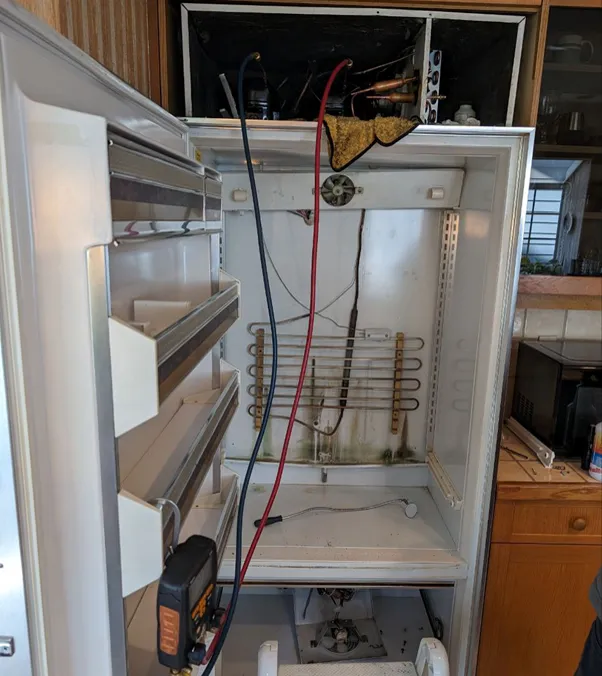
Most freestanding refrigerators are replaced after ten to fifteen years. Sub-Zero built-ins are made to be repaired instead: most parts that wear are reached from the front and replaced without pulling the unit out of its opening, and Sub-Zero has published service and parts literature for each generation, sorted by serial number, back to units built before 1979. That is why many 600 series units are still in service, and why much older ones can be rebuilt. In May 2024 we did a full system overhaul on a 46-year-old Sub-Zero in Orange County.
Two design choices help. The larger combination models have a separate refrigeration system for the fresh-food and freezer sections, so each compressor works only for its own side, and a failure on one side leaves the other cooling. And the cabinet, doors and insulation are built heavier than the parts that wear, so the box usually outlives several rounds of them.
How long each Sub-Zero series lasts
The series tells you the age range, the refrigerant and how hard parts are to find. The model number is on the rating tag inside the unit; the serial number then pins down the generation.
| Series | How old they are now | What decides how much longer it runs |
|---|---|---|
| Before 1979, and the 200 and 300 series | Over forty years | R-12 refrigerant, no longer made, and parts often found only as equivalents. A rebuild works when the cabinet and liner are sound. |
| 500 series | Built from about the 1980s into the 1990s | Simple dial controls and a defrost timer. Units from the 1980s were built with R-12, so sealed-system work usually means converting. |
| 600 series | About twenty to thirty-five years | Two systems on combination models, controls that changed by serial era, and parts mostly still available, some as later replacements. |
| 700 series integrated | The newest are well over a decade old | Machinery at floor level that gathers dust, and door and drawer hardware carrying heavy panels. |
| Classic (BI, now CL) | The earliest BI units are more than fifteen years old | Four BI serial eras with different parts. Most are still young for a Sub-Zero, and later ones may still be inside the sealed-system parts warranty. |
| Designer and Integrated columns and drawers | From new to well over a decade | Hinge and closer wear from custom panels, and a floor-level condenser that needs cleaning more often. |
| Undercounter, wine storage and ice machines | Varies | Small cabinets breathing through a front grille, often in bars and outdoor kitchens. Air flow and heat decide their life. |
More on each line: vintage units, 500, 600, 700, Classic, Integrated and undercounter.
What wears out, and roughly when
This is the pattern we see on Sub-Zero built-ins, not a schedule. A unit with a clogged condenser moves through it faster; a well-kept one slower.
| Age | What usually needs attention | Notes |
|---|---|---|
| First few years | Leveling, door alignment, water supply and ice maker setup, an occasional sensor or control part | Many trace back to the installation. On BI and Integrated era units the first two years were covered in full. |
| Five to twelve years | Condenser fan motor, water valve and ice maker, door gaskets, lights, temperature sensors, the freezer defrost heater | Hard water is tough on valves and ice makers. Fan motors last longest over a clean coil. |
| Twelve to twenty years | Door closers and cams, evaporator fans, control boards and keypads, defrost parts, and the first sealed-system failures | Evaporator leaks and compressors start here. Repair or replace gets serious, and usually still comes out as repair. |
| Twenty years and on | The sealed system on one or both sides, the heaters and warm loops that keep door frames dry, cracked liners, rust at the base | Parts availability and the cabinet start to matter more than the age itself. |
Two jobs from July 2026 show what sealed-system work on a Sub-Zero looks like: an evaporator leak repair in Irvine and a failed freezer compressor in Orange County.
What makes one Sub-Zero last thirty-five years and another fifteen
- The condenser. One of the biggest factors we see. A matted coil keeps the compressor and fan motor hot for years. The condenser cleaning guide shows the safe way and how often.
- Air at the grille. A built-in breathes only through its front grille. Trim that crowds the top grille, or anything stored against the toe-kick, starves the coil of air just as dust does.
- Doors and heavy panels. Custom panels load the hinges and closers. A door that no longer pulls itself shut lets humid air in all day, which means longer runs and more frost.
- Water. A filter changed on time and a supply valve left fully open protect the valve and the ice maker.
- Heat and salt air. A unit in a hot pantry, in afternoon sun or near the coast works harder and corrodes faster. Outdoors, only models built for it belong; see outdoor kitchen refrigeration.
- Small faults fixed early. A squealing condenser fan left for weeks ends as a stopped fan and an overheated compressor. Repeated off-and-on resets are hard on it too.
The warranty, and why year twelve matters
For the BI-era Classic and Integrated units covered by Sub-Zero's service literature, the residential warranty came in three layers. Sub-Zero covered the whole unit for the first two years, the sealed system with labor through year five, and sealed-system parts alone up to the twelfth year, all counted from the day it was installed.
The sealed system means the compressor, the coils and the tubing that carries refrigerant between them. Fan motors and the compressor's start parts count as ordinary parts, so only the two-year coverage includes them. Non-residential units, and display units sold long after they were built, had shorter coverage. Terms vary by era, so check your paperwork.
If a compressor or coil fails inside the first twelve years, call Sub-Zero with your serial number before you pay anyone for the repair, including us. We are an independent service, not affiliated with Sub-Zero Group.
Repair or replace, by age
Age alone rarely settles it. What failed, the shape of the cabinet and doors, and what a replacement really involves in your kitchen decide it.
| Age | Fan, valve, sensor, gasket, closer or defrost part | Compressor, leak or evaporator |
|---|---|---|
| Under 12 years | Repair. | Check Sub-Zero's warranty first. Repair is almost always the answer. |
| 12 to 20 years | Repair. | Usually worth it on a sound cabinet. We check the other system and the doors before we quote. |
| 20 to 30 years | Repair, if the cabinet and doors are sound. | Weigh it. If the other side is just as worn or the liner is cracked, replacement starts to make sense. |
| Over 30 years | Repair, if the part or an equivalent exists. | A rebuild, for owners who want to keep the unit; on R-12 units it includes converting the refrigerant. |
A replacement is rarely a simple swap: it must fit the same opening, panel-ready models need matching panels, and sizes have changed, so an older opening may need cabinet work. An old unit does use more electricity, which counts but rarely decides it alone. The repair or replace guide, the Sub-Zero repair cost guide and compressor replacement walk through the numbers, and sealed-system repair explains the work.
How to find out how old your Sub-Zero is
The rating tag carries the model and serial numbers, and on many units a date code. On Classic units, and usually on 600 series units too, it is by the top door hinge: in the fresh-food section on an over-and-under or all-refrigerator, in the freezer on a side-by-side or all-freezer. On Integrated models it is on a side wall inside the unit.
The serial also places the unit in its generation. A Classic below serial 4100000 is an original BI, one after serial 4380000 the latest BI design. A 600 below serial 1810000 is an original 600, one from serial 2600000 the last run. Read us both numbers and we will tell you the generation, the likely age and which parts are still available.
What keeping it running costs
The service call is $79. It covers the trip and the diagnosis and is applied to the repair when you approve the written price, and that price does not change once work starts. Typical ranges for built-in refrigeration:
Built-in refrigerator and freezer repair (Sub-Zero, Thermador, Viking, Monogram, Miele)
| Repair | Typical price, parts and labor |
|---|---|
| Condenser cleaning and performance check | $150 to $250 |
| Condenser fan motor | $350 to $600 |
| Evaporator fan motor | $350 to $650 |
| Temperature sensor (thermistor) | $250 to $450 |
| Defrost heater or defrost termination | $350 to $650 |
| Water valve | $300 to $550 |
| Door gasket, per door | $300 to $600 |
| Door hinge or closer cam | $300 to $650 |
| Ice maker assembly | $450 to $900 |
| Electronic control board | $650 to $1,300 |
| Refrigerant leak repair and recharge | $900 to $2,000 |
| Evaporator replacement | $1,200 to $2,500 |
| Compressor replacement (sealed system) | from $2,000 |
Typical Orange County ranges for parts and labor. The $79 service call is applied to any of them. Parts that ship from the manufacturer and older or discontinued models can run higher. You get the exact written price after the diagnosis and before any work starts.
A yearly maintenance visit is the cheapest way to add years. See pricing, contact us, or go back to Sub-Zero repair.
Talk to the technician first
Monday to Saturday, 8 AM to 7 PM. The $79 service call is applied to the repair.
Sub-Zero lifespan: questions
How long does a Sub-Zero compressor usually last?
There is no fixed figure. Original compressors past twenty years are common on units whose condenser was kept clean, and a coil left matted for years is the usual reason one fails early.
What finally makes owners replace a Sub-Zero?
Rarely one worn part. Usually it is a sealed-system failure on an older unit that also has tired doors, a cracked liner or rust, or a remodel that changes the kitchen anyway.
Is my Sub-Zero's sealed system still under warranty?
On BI-era Classic and Integrated units, sealed-system parts were covered to the twelfth year after installation, with labor through year five. Check your paperwork and call Sub-Zero with the serial before paying for compressor or coil work in that window.
Do Sub-Zeros with two compressors last longer?
They spread the work: each system runs only for its own section, and when one fails the other keeps cooling. The trade-off is two systems to keep healthy as the unit ages.
Is a used or display Sub-Zero a good buy?
It can be, if you know its age and condition. Read the serial for the generation, look at the condenser and gaskets, and remember that display units sold long after they were built carry shorter warranty coverage.
Should I replace a working 25-year-old Sub-Zero before it fails?
Not for age alone. If it holds temperature, runs normally and the cabinet is sound, keep it and keep the condenser clean. Replace it on your own schedule, such as a remodel, not on a guess about the compressor.