Sub-Zero · Older models
Vintage Sub-Zero Repair and Restoration
A Sub-Zero from the 1970s or 1980s can often be kept running, and some are worth a full rebuild. The cabinet, the doors and whether the sealed system still holds R-12 decide it, and we tell you which parts can still be found before you spend more than the $79 visit.
$79 service call, applied to the repair. Monday to Saturday, 8 AM to 7 PM.
- $79service call, applied to the repair you approve
- In-housesealed-system work: compressors, evaporators, leaks
- Since 2022CA BHGS #50388, EPA-certified
- 90 daysno-fee return visit if the same fault comes back
In short: old Sub-Zeros fail at the condenser fan, the dial thermostat, the freezer defrost parts, gaskets and closers, the heaters that keep the face dry, and eventually the sealed system. Most of that has current equivalents. Sealed-system work on an R-12 unit usually means converting it to a modern refrigerant, which turns a repair into a rebuild.
How old is your Sub-Zero
Sub-Zero made many running changes by serial number, so the serial matters as much as the model when we look for parts. Read both to us from the tag, which on the 500 series sits by the top door hinge. Current Sub-Zero lines are on the Sub-Zero repair page.
- Before 1979. Units before serial 0265837: three and four-digit models, many with suffixes such as BIR, RF or RFD.
- The 200 and 300 series after 1979. Models such as 211, 215, 241, 251, 2511, 3211, 361 and 801. The 245 and 249 undercounter units are on the undercounter page.
- The 500 series. The 501, 511, 532, 542, 550, 561 and 590, built in Madison and Phoenix; the serial starts with M or P for the plant. See 500 series repair.
- Early 600 and 700 series. Old enough to raise the same parts questions, but built on R-134a. See 600 series and 700 series.
R-12 or R-134a, and why it matters
Any Sub-Zero from the 1970s or 1980s was built with R-12. The change to R-134a came at a different serial on each line. On the 200 series undercounter units, those after serial 1211440 use R-134a. The serial tag lists the refrigerant and charge, and we confirm it before quoting.
R-12 is no longer made; what remains is recycled, scarce and expensive, and only an EPA-certified technician may handle it. We are EPA-certified for refrigerant work. A sealed R-12 system that still cools should stay closed. When it must be opened for a compressor or a leak, we usually convert it. R-134a uses a different oil and tolerates almost no contamination, so the conversion must be thorough; it is the heart of a rebuild.
How these older units are built
They are simple by current standards. A thermostat with a numbered dial runs the compressor; on the 500 series the normal setting is 5. On most models the freezer defrosts on a timer with a heater and a thermal limit. On full-size built-ins the compressor, condenser and fan usually sit at the top. Many models run a warm refrigerant loop or a heater around the door openings so the face does not sweat. Most have no circuit board, one reason so many still run.
What fails, most common first
Condenser fan and decades of dust
What it usually is: an original fan motor that has slowed or seized over a coil not cleaned in years. The compressor overheats, trips on its overload and cools in short bursts.
What you can check: listen at the top grille for the fan, and clean the coil with the power off using the condenser cleaning guide.
What we do: fit a current equivalent motor, clean the coil, and test the start relay and overload, which take the heat when the fan is weak.
Dial thermostat
What it usually is: contacts worn or stuck closed, so the compressor runs nonstop and freezes food, or a sensing bulb that has lost its charge, so the compressor never starts or the unit runs warm.
What you can check: that the dial was not turned off or to the warmest number, and whether a colder number starts the compressor within a few minutes.
What we do: fit an equivalent control and set it by measured temperature, not the dial number. See running constantly.
Freezer defrost: timer, heater, limit
What it usually is: a timer that stopped advancing, a heater that burned open, or a limit that no longer closes. The freezer cools well for days, then fades as frost seals the evaporator.
What you can check: frost on the freezer's back wall or ice in the drain area. Do not chip at it.
What we do: test all three, replace what failed, check the drain heater and thaw the evaporator. See frost buildup.
Gaskets, closers and hinges
What it usually is: hardened, shrunken gaskets, and closers or door stops worn by decades of heavy panels. Sub-Zero issued closer and door-stop kits for some of these models.
What you can check: from halfway open the door should pull itself shut. Look for gaps and flat spots in the gasket.
What we do: fit the original gasket where it still exists, or the closest current profile made to size, and rebuild the closer. See door not closing.
Sweating face or a leaking loop
What it usually is: the heater or warm loop around the door openings has failed, so the face sweats and can stain or swell the woodwork. A leak in that loop is a sealed-system leak buried in foam, so the usual repair takes the loop out of the circuit and fits an electric heater instead.
What you can check: moisture or rust along the freezer opening, worst on humid days near the coast.
What we do: test the heaters, find the leak, and fit a heater kit where bypassing is the sound fix.
In-unit ice maker and water valve
What it usually is: a worn ice maker, a valve scaled by hard water, or a frozen fill tube. Parts for the oldest ice makers are often gone.
What you can check: the shutoff valve, and that the ice maker is switched on.
What we do: repair it where parts exist or fit a current ice maker that suits the freezer. See ice maker not working.
Compressor and sealed system
What it usually is: a worn compressor or a leak at the evaporator, a joint or the loop. A knock as the compressor stops is more often its mounts or a touching tube.
What you can check: that the coil is clean and the fan turns. If it still will not cool, the rest needs gauges.
What we do: read the system, tell you whether it still holds R-12, and quote a repair or a conversion in writing. See compressor replacement and sealed-system repair.
What a full rebuild involves
When the cabinet, doors and insulation are sound, we plan one job instead of a string of repairs:
- Sealed system: we remove the old refrigerant, fit a new compressor and filter, flush the lines, fix or bypass a leaking loop, dry the system under vacuum and fill it with a measured charge of a modern refrigerant.
- Parts around it: condenser fan motor, start relay and overload, thermostat, defrost timer and heater, brittle connectors.
- Cabinet: gaskets, closers, hinge adjustment, and a full cleaning of the machine compartment.
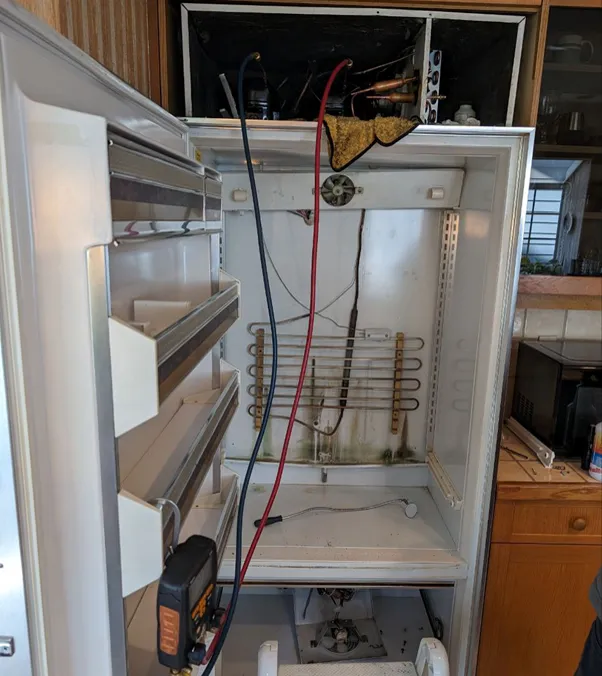
We price it in writing as one job, say which parts are original Sub-Zero and which are equivalents, and give lead times up front. In May 2024 we did a full system overhaul on a 46-year-old Sub-Zero in Orange County; the photo at the top is from that job.
Repair or replace an old Sub-Zero
On a vintage unit the cabinet and the opening matter more than age, because a current model may not fit without cabinet work and new panels.
| Situation | Usually |
|---|---|
| Fan, thermostat, defrost part, gasket or closer failed; sealed system healthy | Repair. Parts or equivalents exist and the cost is modest. |
| Sealed system failed; cabinet, doors and liner sound | Price the rebuild against replacement plus the cabinet work. |
| Sealed system failed; liner cracked or rusted, doors sagging | Replace. A new system in a tired cabinet is money in the wrong place. |
| Runs, but loud, sweating or never stopping | Have it checked. Often a fan, a heater or a dirty coil. |
The lifespan guide and repair or replace guide go further.
Stay safe. Do not add refrigerant from a can, including so-called R-12 drop-ins: mixed refrigerants and additives contaminate the system. Do not pull a built-in out yourself; it is heavy and can tip. Scorched or crumbling wiring at the top grille means breaker off, then call.
What it costs
On an older unit the $79 visit includes checking which parts can still be found; it goes toward the repair or rebuild once you approve the written price, and that price stays fixed once work starts. A rebuild combines several lines below.
Built-in refrigerator and freezer repair (Sub-Zero, Thermador, Viking, Monogram, Miele)
| Repair | Typical price, parts and labor |
|---|---|
| Condenser cleaning and performance check | $150 to $250 |
| Condenser fan motor | $350 to $600 |
| Evaporator fan motor | $350 to $650 |
| Temperature sensor (thermistor) | $250 to $450 |
| Defrost heater or defrost termination | $350 to $650 |
| Water valve | $300 to $550 |
| Door gasket, per door | $300 to $600 |
| Door hinge or closer cam | $300 to $650 |
| Ice maker assembly | $450 to $900 |
| Electronic control board | $650 to $1,300 |
| Refrigerant leak repair and recharge | $900 to $2,000 |
| Evaporator replacement | $1,200 to $2,500 |
| Compressor replacement (sealed system) | from $2,000 |
Typical Orange County ranges for parts and labor. The $79 service call is applied to any of them. Parts that ship from the manufacturer and older or discontinued models can run higher. You get the exact written price after the diagnosis and before any work starts.
On a rebuild, as on any repair, seniors and veterans get 20% off and repeat customers 15%. Rates are on the pricing page; newer built-ins are on built-in refrigerator repair.
Talk to the technician first
Monday to Saturday, 8 AM to 7 PM. The $79 service call is applied to the repair.
Vintage Sub-Zero: questions
Can a 30 or 40-year-old Sub-Zero still be repaired?
Often, yes. Most wear parts have current equivalents, and the sealed system can usually be rebuilt. What usually ends one is a cracked or rusted liner, not the machinery.
My old Sub-Zero uses R-12. Can you recharge it?
R-12 is no longer made and what remains is scarce. If the system has to be opened, we usually convert it to a modern refrigerant with a new compressor and drier.
Are parts still available for Sub-Zero 200 and 300 series units?
Many electrical parts have current equivalents. Trim, shelves, some door parts and model-specific pieces are often gone, so we check your model and serial before you commit.
How do I tell what year my Sub-Zero was made?
The model and serial on the tag tell us the family and era. Units before serial 0265837 are pre-1979, and on the 500 series an M or P at the start of the serial marks the plant.
Why is the front of my old Sub-Zero wet around the freezer door?
Usually the heater or warm loop keeping the face dry has failed. A heater is replaced; a leaking loop is usually bypassed with an electric heater kit.
Do I need a Sub-Zero technician for a unit this old?
No. We are an independent service, not affiliated with Sub-Zero Group, and we do sealed-system work and full rebuilds on older built-ins in-house.