Sub-Zero · Troubleshooting
Sub-Zero Refrigerator Too Cold or Freezing Food
A Sub-Zero that freezes food in the refrigerator is usually set too cold or running on a sensor or control that no longer tells the compressor when to stop. A display that reads 3 is in Celsius, not too cold. On most built-ins the freezer cannot be the cause, because the refrigerator has a compressor of its own.
$79 service call, applied to the repair. Monday to Saturday, 8 AM to 7 PM.
In short: confirm the set point (38°F from the factory) and that the display is in Fahrenheit, then measure with a thermometer in a glass of water on a middle shelf overnight. If it keeps getting colder whatever you set, or the Service icon flashes with a chime, a control or sensor fault is likely keeping the compressor on, and that needs a visit soon.
First, make sure it really is too cold
The number on a Sub-Zero display is a smoothed average of the compartment, not a spot reading, so an air thermometer against the back wall or in a crisper will usually read lower. That alone is not a fault.
- Measure it properly. Stand a thermometer in a glass of water on a middle shelf, close the door and read it the next morning. Water ignores the gusts of cold air that make an air thermometer jump. Anything from 36 to 40°F is right; at 35°F or below, the coldest spots can freeze.
- Check the set point. Sub-Zero ships refrigerators at 38°F, and Classic Series controls accept 34 to 45°F. At 34 or 35°F the coldest corners sit right at freezing. Raise it a degree at a time with WARMER and allow a day between changes.
- Check the units. If the refrigerator reads between 1 and 7 and the freezer between minus 21 and minus 15, the display is in Celsius: 3°C is about 37°F and nothing is wrong.
- Look at what freezes, and where. Food against the back wall or the air openings on the evaporator cover catches the coldest air. On Classic side-by-side and all-refrigerator models some coil air is released just above the drawers, so they run about two degrees colder than the shelves. Over-and-under models, French-door ones included, do not have this colder drawer arrangement.
- Look for a Service icon. Lit or flashing, sometimes with a chime, it means the control has logged a fault it could not correct. Note what it shows before switching anything off.
What it usually turns out to be
On a Classic Series, PRO 48, Integrated or later 700 series unit, the refrigerator has its own compressor and evaporator, and nothing from the freezer side reaches it. So when the fresh-food section freezes food at a normal setting, the cause is in its own controls: the sensor that measures it, the board that switches its compressor, or the way that board was set up. A few older single-system designs add one more suspect, an air baffle.
Set point, loading and air flow
What it usually is: a refrigerator set to 34 or 35°F, containers pressed against the back wall, or produce at the very bottom of a side-by-side's drawers. The control does a little to protect the drawers at low settings, but it cannot make up for a setting at the bottom of the range.
What you can check: set 38°F, leave a finger's width between food and the back wall, and keep delicate greens out of the spot where things freeze.
What we do: if food still freezes after that, we test the sensor and the board.
Refrigerator sensor reading wrong
What it usually is: the compartment sensor, a small thermistor, drifts so that it reports the cabinet warmer than it really is. The control keeps cooling toward a temperature it thinks it has not reached. A drifting sensor sets no code. One that fails outright does: on Classic Series units EE replaces the refrigerator temperature and the control falls back to running the compressor on a fixed timer. A timer ignores the room, so in a cool kitchen it overcools.
What you can check: EE on the display, or a set point that seems to change nothing. See Sub-Zero error codes.
What we do: compare the sensor with a reference thermometer at the same spot, check its wiring and mounting, and replace it.
Compressor relay stuck closed
What it usually is: the relay on the control board that switches the refrigerator compressor welds itself shut, so the compressor has power around the clock whatever the control asks for. The refrigerator gets colder by the day and drinks at the back turn to slush. Later Classic Series controls notice this and flash the Service icon with a chime.
What you can check: a refrigerator that keeps dropping after you set it warmer, and a compressor that never goes quiet. Our page on a Sub-Zero running constantly covers the other reasons a compressor never stops.
What we do: confirm it at the board, tell you the lead time for a new board, and set the new one up for your model when we install it.
Control set up for the wrong model
What it usually is: a replacement control board that was never configured for the cabinet it went into. It then runs another model's temperature and defrost settings, and the temperatures come out wrong in either direction.
What you can check: whether the trouble started right after a board was replaced.
What we do: read the model setting stored in the control and correct it, often with no new part.
Air baffle or duct seal on older designs
What it usually is: the earliest 700 series tall combinations, built before serial 1670316, cool the refrigerator with freezer air passed through a baffle, and the original 700TR from the same era uses baffles to run each drawer zone up to about 3°F colder than the one above. Some UC-24 undercounter models have a motorized baffle too. A baffle stuck open, or a worn duct seal, lets too much cold air through.
What you can check: freezing confined to one zone of a 700 series unit while the others are normal.
What we do: test the baffle and its control, check the duct seals, and repair what sticks. Some parts for these older units are hard to find, and we say what can be sourced before you decide.
If it is the freezer that is too cold
A Sub-Zero freezer normally sits at 0°F, and Classic Series controls go down to minus 5°F. A reading between 0 and minus 5°F usually means Max Ice is on (several ice cube icons: the freezer is held at minus 5°F with its fan running for a day, then returns to your setting) or the set point was lowered; a freezer well below minus 5°F points at the relay and sensor faults above. Max Ice does not affect the refrigerator section of a dual-system unit.
How it differs by series
- Classic Series (BI): a set point of 34 or 35°F is the usual cause; EE or a flashing Service icon points at the sensor or the board instead. See Classic Series repair.
- Integrated and Designer: a refrigerator column is cooled only by its own system, so look at its own settings and sensor, not at the freezer column beside it. See Integrated repair.
- 600 series: electronic controls that are now twenty years old or more, so sensor drift and tired boards are more common simply with age. See 600 series repair.
- 700 series: the early tall units with air baffles are the main Sub-Zero design where freezer air can freeze refrigerator food. See 700 series repair.
- Undercounter refrigerators and drawers: small compartments react fast, and a can against the evaporator cover can freeze in an otherwise normal drawer. See undercounter repair.
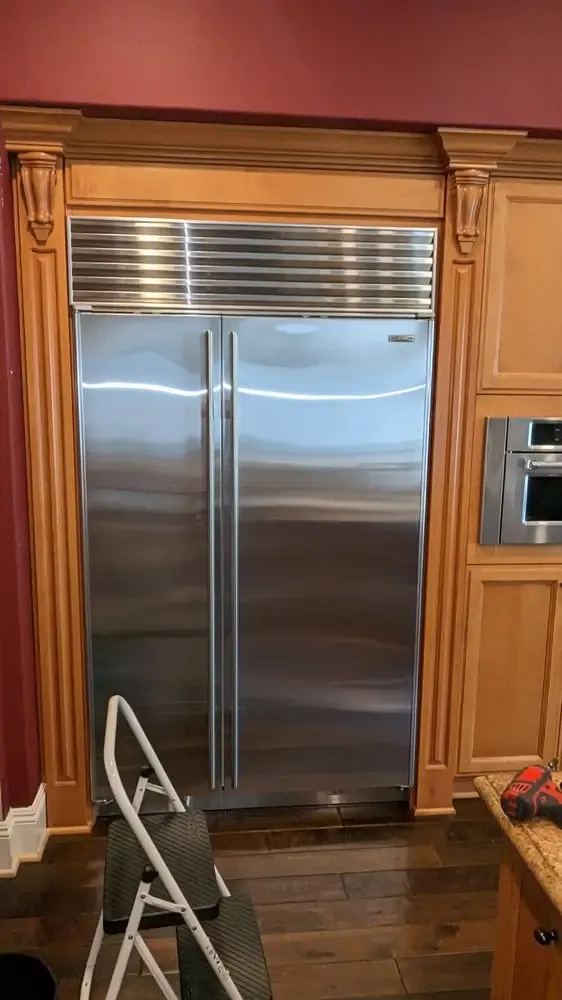
Do not let it run cold for weeks. A stuck relay or bad sensor keeps the compressor running without a break, which wears it. Glass bottles and cans that freeze can burst, so move them to the door shelves until the repair. If raising the set point changes nothing within a day, call.
What the repair costs
The service call is $79 and is applied to the repair when you approve the written price. Food freezing in the refrigerator is usually a setting, a sensor or a board, so the sensor and control board rows apply most often:
Built-in refrigerator and freezer repair (Sub-Zero, Thermador, Viking, Monogram, Miele)
| Repair | Typical price, parts and labor |
|---|---|
| Condenser cleaning and performance check | $150 to $250 |
| Condenser fan motor | $350 to $600 |
| Evaporator fan motor | $350 to $650 |
| Temperature sensor (thermistor) | $250 to $450 |
| Defrost heater or defrost termination | $350 to $650 |
| Water valve | $300 to $550 |
| Door gasket, per door | $300 to $600 |
| Door hinge or closer cam | $300 to $650 |
| Ice maker assembly | $450 to $900 |
| Electronic control board | $650 to $1,300 |
| Refrigerant leak repair and recharge | $900 to $2,000 |
| Evaporator replacement | $1,200 to $2,500 |
| Compressor replacement (sealed system) | from $2,000 |
Typical Orange County ranges for parts and labor. The $79 service call is applied to any of them. Parts that ship from the manufacturer and older or discontinued models can run higher. You get the exact written price after the diagnosis and before any work starts.
If the compressor has been running nonstop, we check it on the same visit. For a warm freezer instead, see freezer not freezing; every Sub-Zero symptom is on our Sub-Zero repair page, and pricing and built-in refrigerator repair cover other brands.
Talk to the technician first
Monday to Saturday, 8 AM to 7 PM. The $79 service call is applied to the repair.
Sub-Zero freezing food: questions
Why does my Sub-Zero freeze lettuce in the crisper drawer?
On Classic side-by-side and all-refrigerator models the drawers run about two degrees colder than the shelves by design. With the set point at 34 or 35°F that puts them at freezing; set 38°F and keep produce away from the back of the drawer.
What temperature should a Sub-Zero refrigerator be set to?
38°F, the factory setting, suits most kitchens. Classic Series controls accept 34 to 45°F; below about 36°F expect some freezing in the coldest spots.
My display reads 38 but my thermometer says 33. Which is right?
Probably both, in different places. The display shows a smoothed average; an air thermometer near the back wall catches the coldest air. A thermometer in a glass of water on a middle shelf overnight settles it.
Can the freezer make my Sub-Zero refrigerator too cold?
On most built-ins, no, because the refrigerator has its own compressor and evaporator. The exceptions are older single-system designs such as the earliest 700 series tall units, which feed freezer air to the refrigerator through a baffle.
Why does my Sub-Zero display show 3 and minus 18?
It is set to Celsius. 3°C is about 37°F and minus 18°C is 0°F, both normal. The use and care guide shows how to switch back to Fahrenheit.
Is a refrigerator that runs too cold bad for the compressor?
If the cause is a setting, no. If the compressor never stops because of a stuck relay or a bad sensor, yes: it runs without rest and wears faster, so have it checked within days, not weeks.